Professional Portfolio
This teaching page presents a summary of my professional teaching experience and educational philosophy as I draw nearer to completion of my Bachelor of Technology Education.
Professional Teaching Experience
In May 2015 I began my first 5 week practicum experience with the TAS department at St Paul's Catholic School, Manly, NSW. I am very grateful that the staff of St Paul's afforded me the opportunity, excellent guidance and support during this prac.
The prac entailed a 1 week orientation and observation period followed by 4 weeks of teaching years 7, 8 9 & 10 at a 50% load. Years 7 & 8 were working to the BOSTES stage 4 Technology (Mandatory) Syllabus, while years 9 & 10 were working to the stage 5 Industrial Technology Syllabus electives of multimedia and timber, respectively.
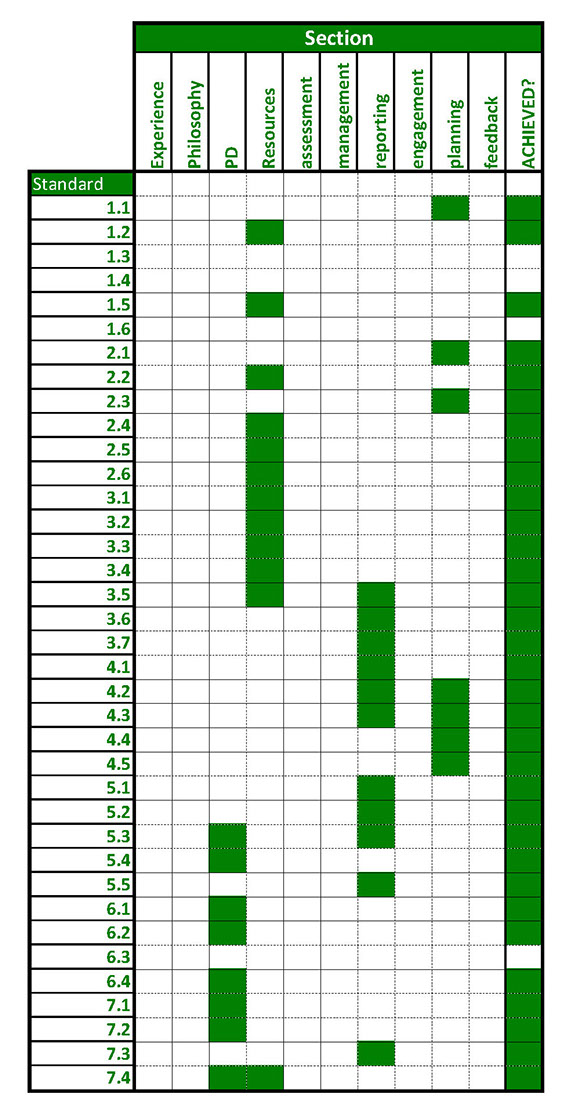
The Australian Professional Standards for Teachers define the knowledge, practice and professional engagement needed for high quality, effective teaching that improves student learning outcomes1.
Evidence of my application of the Standards in teaching can be viewed by clicking links within within this webpage. To view standards in the context of evidence provided simply follow STANDARD link in the right margin, a pop-up window should appear. Reference to specific standards are listed in brackets. To eliminate duplicity, and due to the workload of annotating all standards within each evidence, note that some evidence deliberately omits standards despite their obvious application within the evidence. The standards link to the right is a test.
1 http://bit.ly/1KUfoUD
Cameron Mills


Teaching Philosophy
Considering (at time of building this site) I have just finished my first prac, my teaching philosophy remains a work in progress.
Education is a fundamental human need. Like air, water, food, sleep and love, life is difficult without it. As professional educators we must ensure all children access education in as many ways as possible, doing what we can to ensure barriers are removed and opportunities encouraged.
TAS is a practical subject area that inspires industriousness and creativity in students. In my experience the project-based nature of TAS appeals to students and offers meaningful prospects for them to develop their own educational interests within alternate learning environments. The practical application of tools and technologies across the technological spectrum exposes students to opportunities presented in no other KLA.
Our world is in a process of profound change, rapidly facilitated by computing. The World Wide Web was pure sci-fi just 30 years ago3. "Software is eating the world" 4 and as technology teachers we are obliged to address this reality. I do not subscribe to teaching all students coding. The issue is much broader. Consider the local impacts of free trade, global outsourcing and digital manufacturing. We must be aware of, address and invest in future realities. We must also acknowledge the history of just how we got here, and that traditional skills remain relevant for the 21st century TAS student who is often not quite interested in, or ready for global domination.
As professional teachers we should embrace professional development. Just as one may be reluctant to trust their medical treatment to a specialist who doesn’t engage with the latest scientific developments why should society entrust education to teachers who do not embrace their own ongoing education & development through life-long learning?
Les Carlyon laments the Allied Commander-in-Chief of the ill-fated Gallipoli campaign. Sir General Ian Hamilton was both “fascinated and repelled by the modern in equal measure”1. He “didn’t realise war was now about the triumph of technology and organisation as well as triumph of the spirit”2. As we commemorate Gallipoli’s centenary the situation remains analogous, be it in the theatre of war, commerce, industry, art or education. Technology is a foundational influence upon the outcome of human endeavour and as technology educators I believe we are obliged to develop in our students an appreciation for its history, an understanding of its currency and an imagination for its future.
My final point maybe difficult to articulate but if I had understood and believed in it when I was in school, I am sure I would have had more confidence and possibly ambition following school. When I began this course a sage lecturer advised her mantra - "you can do this". In my late twenties my eldest brother explained to me "people made it, people can fix and improve it". At the annual IIATE display I see inspiring work by 17 year-old students and know now, we are all capable of pushing ourselves, we just need to find the confidence and trust in ourselves to take a risk and go harder. That's what I want to teach my students; have faith, work hard, find mentors, take risks and dare to aspire.
Cameron Mills – June 2015.
Teaching Resources
The TAS department at St Paul's has a wide range of quality teaching resources and I could have simply used these to support my teaching and assessment programs. However I wanted to test my skills and challenged myself to develop a range of resources from scratch, and also give back something to St Paul's (if they deemed them suitable). I also adapted one or two St Paul's documents and of course resorted to YouTube and the like for additional content. The process proved time consuming and tiring although I am pleased to know some will be put to good use for future year groups.
Below is a contextual summary of some resources prepared and their use.
- Both years 8 & 9 had tasks relating to video design & production. In an effort to model to and inspire my students, I planned, captured and produced a short video clip that had may of the elements the students would be expected to incorporate into their own productions. The result was filmed on 22nd May, 2015, opening night of Vivid Sydney. I subsequently showed it to both classes and found it to be a very worthwhile teaching resource as it encouraged discussion of processes, modelled expectations and invited exploration for their own video productions. Video below.
- Year 7 study built environments and have to design "The Ultimate Skatepark". I created an animation in SketchUp designed to motivate interest and model potential design opportunities to students, whilst also hinting at the software potential (i.e. SU Warehouse and animation functionality). The video was hosted on my TeachDandT Youtube channel and St Paul's then added it to their Lighthouse learning site for all year 7 students (about 150) to view (3.4 & 3.5).
- A research task incorporating an embedded literacy activity was designed for Year 7. Students were grouped in small teams competing to draft the best email Manly Council (according to set criteria) so they could learn about the development processes within a legislative framework. Planning the process ensured the result was a big success (2.5, 2.6, 3.2, 3.3 & 7.4).
- As I entered my 2nd week teaching year 7, 8 & 9 were all finalising their projects and portfolios. A major component is the project evaluation and I designed a task that could be used across both stages. The task had a significant literacy component and was intended to elicit a narrative evaluation through scaffold prompts. Definitions and a list of KLA key words were included to support students. The task allowed differentiation across the range of learning needs (relevant to my class) through scaffolding. Where necessary students worked with a sample task that modelled linkages and a response. The task was accepted by my supervising teachers and a learning support teacher requested a copy for her own resources (hopefully not as an example of poor practice!) (1.2, 1.5, 2.2 & 2.5).
- During my prac I made regular use of various ICT resources including digital projector, PC's, web (Youtube - Vimeo etc), shared drives to host curated multimedia content. An ancient super 8 projector was even thrown into the mix as a demonstration of historical development in multimedia (2.6).
- I brought my own coffee table in to discuss planning and project processes with year 10. A discussion on the drawings and documentation also served to inspire challenging goals to students. (3.1)
- Following prac I prepared an instructional screen recording to support staff and future students in the use of Sketchup to complete a drawing aligned with a unit of work for Industrial Tech Timber. Video Below.
- An opportunity presented for an excellent year 8 video lesson. In planning my lesson on the importance of soundtrack & script for effective films I found Yothu Yindi's Treaty video clip. I found the lyrics online and downloaded it. Using the same software (Sony Vegas) the boys had to use in their project I inserted a cultural warning to preface the clip (as lead singer Mandawuy Yunupingu is deceased), a link for boys to research more background info on the band, and the song lyrics so they could really know the band's message. During the lesson I screened the clip. They loved it and also learned something of the value of a politician's promise. The clip encouraged a lot of class discussion, hopefully inspiring students to be more understanding and respectful of Aboriginal history, culture and language (2.2, 2.4, 2.6, 3.2, 3.4).
Lesson Planning
During observation week I realised I was struggling to maintain organisation of various information relating to my scheduling. I had been given a timetable however I also needed other info like lesson & break times, classroom facilities, week cycle days and unit of work deadlines. This info was across several documents so I took some time to prepare a concise colour coded document which was then inserted into the sleeve of my diary. I arranged folders of the same colour for year groups and this all proved to be time well invested as I am yet to hear that I missed a lesson, or let anyone go late for their lunch. I feel good organisation might be the best first step to successful lesson planning. Strangely there doesn't appear to be a graduate standard for being well organised.
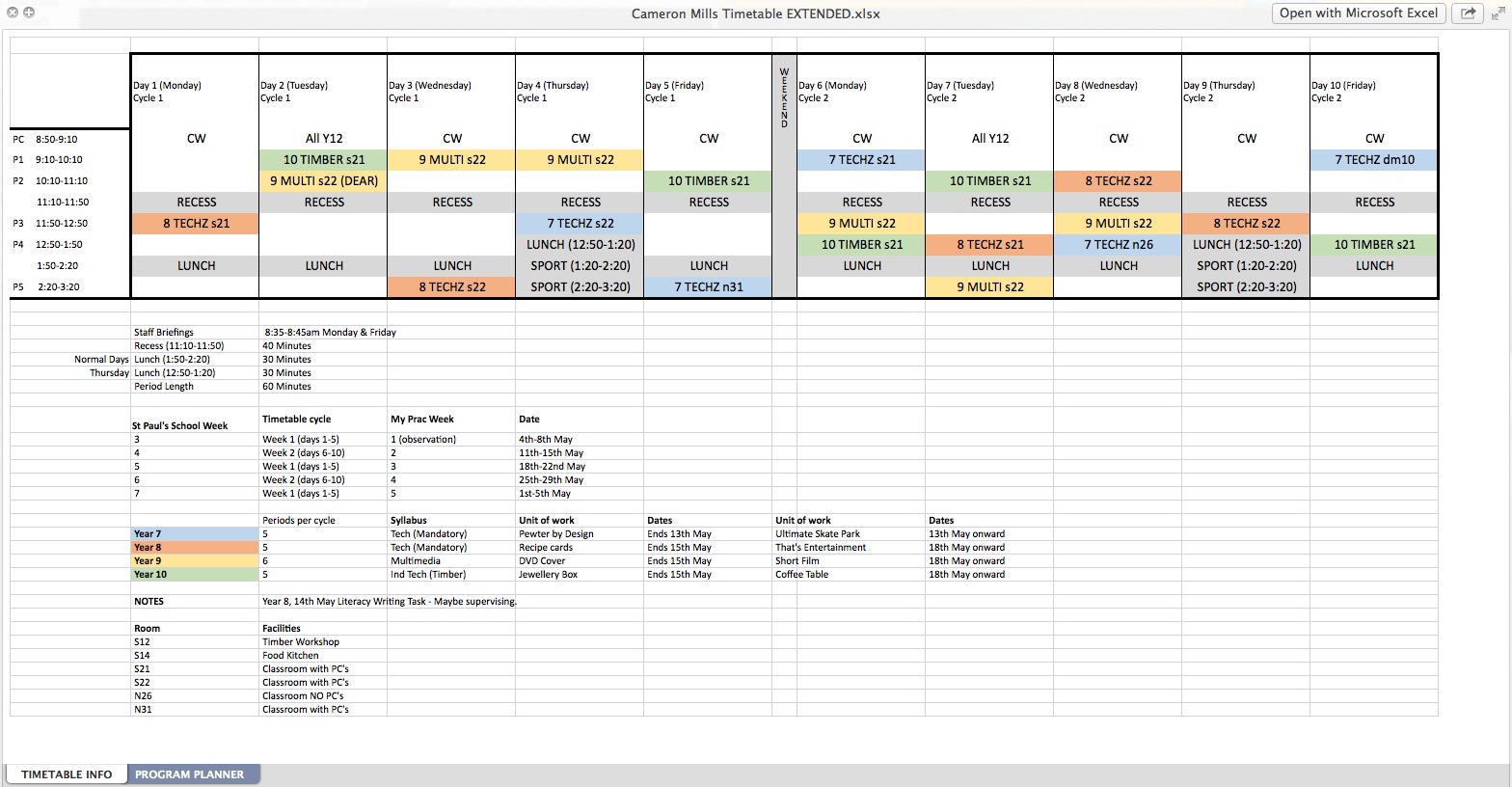
- During my observation week I was supplied with eight St Paul's teaching and assessment programs, that is 4 each for previous units being completed and 4 each for new units I was starting with students. These documents detailed appropriate syllabus outcomes and offered many suggestions for classroom curriculum. I drew upon these documents to refine the scope & sequence my lesson planning over the four weeks of teaching (2.3).
- Reflecting upon a lesson on the relevance of classification in today's world, esp' considering that the web enables practically unfettered access to all levels of content (via both streaming services and social media) students learned of the range of disparate international classifications for the same film. Discussion revealed, by and large, that self-regulation is necessary. Although traditional classification mechanisms remain valid as cultural guides they maybe becoming increasingly irrelevant (4.4 & 4.5).
- Each lesson required a detailed lesson plan to be prepared. Following each lesson I recorded my reflections on the lesson, what went well, what didn't and what I would have changed (if I drove a Tardis). The attached sample lesson plan was from my final year 8 class in week 7 (1.1, 2.1, 4.2, 4.3).
Behavioural & Classroom Management
This section does not detail many standards as they have been addressed elsewhere. In the interest of reflection I have noted some learnings from my St Paul's Prac.
- On the first week I was assigned to an experienced teacher and we took approx 30 year 9 boys to the beach to play volleyball. They were very lively and the teacher explained a great strategy of simply stopping the boys to sit and reset when able. This occurred once we had walked to the beach, during a training discussion and also prior to being dismissed. The process isn't so much about sitting, rather just creating an opportunity to break and move into the next activity in a calmed fashion. It was very effective!
- When I first began prac all three supervising teachers offered advice (written & verbal) on how to better manage my classroom's behaviour. Thanks to their suggestions I feel the improvement in my class management at prac end was significantly better. Without copying the whole observation guide a hard copy is available on request (and has been submitted to SCU for review and recording keeping) - A copy from a page of this report is attached (3.5, 4.2 & 4.3).
- Through direct observation and staff discussion I found different influences, including time of day, day of week, weather and other influences including exams had an impact on student behaviour.
- An observation from the staff development day is that some students displayed a lack of behavioural respect in the classroom for female teachers. Without making judgement on this I feel it is an issue for the school to address in support of those teachers and the other students who are affected by it.
- I observed several other classes and a notable lesson was year 9 science with an experienced and dedicated teacher who managed the class with with aplomb. Through very active teaching strategies student interest, engagement and discipline was maintained.
- TAS is by nature a KLA with many practical activities. I found student's behaviour between the classroom and workshop/computers to generally be quite different. Practical tasks are generally very positive for students and they benefit from the application of hands-on learning.
FEEDBACK
According to Southern Cross University requirements at the completion of each practicum the supervising teacher presents a report on their assessment of the pre-service teacher's performance against the AITSL standards.
Assessment
During the prac a range of summative and formative assessment activities were designed and/or completed. These included;
- Marking process of year 8 folios in consultation with supervising teacher.
- New evaluation resource for years 7, 8 & 9
- Short film review year 8
- Sketchup activity year 10
- Drawing interpretation activity year 10
- Year 8 exam supervision of reading task for staff PD day
- Year 9 multi 'classification and the law' worksheet
- Year 9 PMI video production analysis.
Reporting
- In the final week of prac I collected all year 8 folios and prepared an assessment tool to report student evidence of learning to to my supervising teacher. This process confirmed a pattern of minimal effort and engagement by some students (as was the case prior to my prac teaching) and the teacher selected these students for one on one counselling. I recognised the solid efforts by many students and thanked them for it (5.1, 5.2, 5.3).
- The above assessment/reporting process provided sufficient evidence for my supervising teacher escalate the issue to the students' parents. Several emails were sent to parents to advice of poor effort by students, esp with folio work. I elected not to request copies of this evidence on privacy grounds, however my supervising teacher would vouch that I was involved in the discussion as to which boys' parents should receive the communication and the content therein (3.6, 3.7, 4.1, 7.3).
- On the 6th May I observed 2 hours (approx 20 interviews) with various supervising teachers as they hosted parent/student/teacher interviews. I can reflect that this process is quite a marathon for teaching staff with 5 minute interviews running from 9am to 7pm, plus a follow up evening session (5.5).
Professional Engagement
An observation from teaching at St Paul's is the frequency and quality of professional conversations I heard within the staff room. Obviously this is a very important aspect staff development and I was pleased to be a part of it when able. Some of the activites I involved myself in were;
- All resources created during prac were circulated to my three supervising teachers so they could use at later dates as required for a) portfolio marking, b) exam preparation c) following year groups. As I finished my prac I tried plan a final lesson so the return to those classes would not be so onerous for the supervising teachers.
- Following the prac I sent an email with link to access downloads of many of the resources completed by myself during uni (see academic page on this site). This included some useful graphics resources including Photoshop, Premiere Pro and SketchUp.
- Staff room discussions with all supervising teachers to address appropriate modifications to my teaching performance and also assessment tasks.
- I had regular discussions with the ICT manager to understand (and perhaps resolve) occasional student network/ICT issues, esp in relation to larger video files and practical data management strategies.
Professional Development
- Over the 5 week prac period I attended all general staff meetings on Monday and Friday mornings. At this time various staff presented issues and information to colleagues, including sports results, charity events and KLA happenings. The principal and deputy principal always presided and would present high level issues including important staffing & student welfare issues, awards in recognition of outstanding staff achievement, planning advice for exams and professional development, policy advice and general counsel such as appropriate discussion strategies for parent teacher interviews, etc (7.1 & 7.2).
-
Pupil-free day. 6 hours professional development, 5th June 2015. The day was divided into two productive developmental activities.
- Mr Greg Miller, Catholic Schools Office Secondary Education Consultant, and Principal Mark Baker chaired a presentation to all staff on the National School Improvement Tool (including video in the link) and drew parallels between the 3rd domain of the NSIT, A culture that promotes learning with the "cultural ideal" of St Paul's of being "distinctly Catholic" and employing "effective mechanisms for ongoing review". As a means of school-wide reflection and self-review random groups of 6 staff worked together to consider St Paul's ranking (from Low, Medium, High or Outstanding) per page 7 of the National School Improvement Tool. The feedback was anonymously complied into a Google Document. Upon completion of the exercise tabulated responses were presented to all staff for review and discussion. Generally opinions were similar and priority issues were identified for ongoing management. Of particular note during this session the Principal noted his views on 'evidence' in relation to the data... evidence does not have to include data. 'Data' implies all evidence is measurable against a quantifiable norm. In fact, in teaching the case is that evidence can be gained through discussion and observation also (7.4).
- The second PD activity involved a literacy task where all teachers pilot marked a year 8 literacy task on the topic of leadership. This activity was productive and highly informative, not only for the purpose intended to develop teaching understanding of the range of student grade samples, but also as it revealed a possible cause of the inappropriate use of text types by students across other KLAs. Science and history teachers expressed concern that their students were using inappropriate persuasive text types where other text types should be employed. This finding was referred back to the english KLA lead and deputy principal (6.1, 6.2 & 6.4).
- On May 13 I attended a staff meeting that was chaired by external curriculum expert Jennifer (McKowski sp?). The purpose of the meeting was to discuss an ongoing 'wrap' activity where assessment data is analysed across KLAs. The chair's focus was to inform and advise staff, particularly in relation to HSC preparation, that pre-HSC marking criteria must sufficiently challenge students or else negative HSC scaling will adversely affect the whole KLA cohort of HSC candidates. Each KLA lead teacher presented their planning for improvement of the teaching and assessment process leading up to HSC (5.3 & 5.4).
STANDARDS MAPPING